
Strategic Buyer’s Guide to Next-Generation Robotic Assisted Surgery Devices: Technology Trends, OEM Sourcing, and CDMO Manufacturing Innovation
An authoritative analysis of high-precision sub-assemblies, kinematic end-effectors, sub-micron tolerances, and contract manufacturing strategies for enterprise procurement teams scaling surgical robotics platforms globally.
The surgical robotics ecosystem is undergoing an unprecedented paradigm shift. As hospitals, ambulatory surgical centers (ASCs), and multi-specialty healthcare networks accelerate the integration of surgical robotics, global original equipment manufacturers (OEMs) face mounting pressures to reduce time-to-market, minimize supply chain fragility, and achieve sub-micron precision across high-duty-cycle mechanical components. Modern Robotic Assisted Surgery Devices require a blend of complex micro-machining, additive manufacturing, biomechanical compatibility, and validated sterilizability. Choosing the optimal Contract Development and Manufacturing Organization (CDMO) partner has transitioned from a operational transaction to a critical core-competency strategy for global MedTech leaders.
This technical guide outlines the core engineering considerations, procurement criteria, regulatory hurdles, and technological innovations shaping the future of Robotic Assisted Surgery Devices. Built upon decade-spanning contract manufacturing insights and backed by Paragon Medical’s global infrastructure, this analysis provides procurement executives, principal design engineers, and commercialization leaders with actionable clarity for strategic decision-making.
Global demand for multi-articulated robotic instruments is projected to expand at a compound annual growth rate (CAGR) exceeding 16.4% through 2032. OEM failure rates during clinical translation are most frequently driven by sub-component tolerance stack-up errors, friction-induced fatigue in drive cables, and unoptimized Design for Manufacturability (DFM). Partnering early with an end-to-end CDMO mitigates late-stage engineering changes by up to 40%.
1. Anatomy & Engineering Portfolio: Advanced Robotic Assisted Surgery Devices
To meet the rigid kinematic standards of soft-tissue and hard-tissue robotic interventions—ranging from urological, gynecological, and general surgery to orthopedic joint reconstruction and spine guidance—robotic hardware must execute precise movement without mechanical backlash or hysteresis. Paragon Medical designs, machines, and packages critical robotic sub-assemblies engineered for zero-compromise clinical performance.

Articulating Wrist Mechanisms & End-Effectors
Multi-degree-of-freedom micro-wrists delivering 7+ degrees of freedom in ultra-confined surgical fields. Engineered with custom micro-gears, pulleys, and tungsten wire rope interfaces.
- • Micro-CNC machining down to ±0.0001” (2.5µm)
- • Laser welding & non-destructive testing (NDT)
- • Materials: 17-4PH, Titanium Grade 5, Custom Alloys

Additive Metal & Structural Robotic Arms
Complex geometric components printed using Direct Metal Laser Sintering (DMLS). Features internal cooling channels, lightweight lattice structures, and high stiffness-to-weight ratios.
- • EOS Titanium Ti6Al4V & Stainless 316L
- • Porous structures for bone-ingrowth integration
- • Post-print HIP (Hot Isostatic Pressing) & CNC finishing
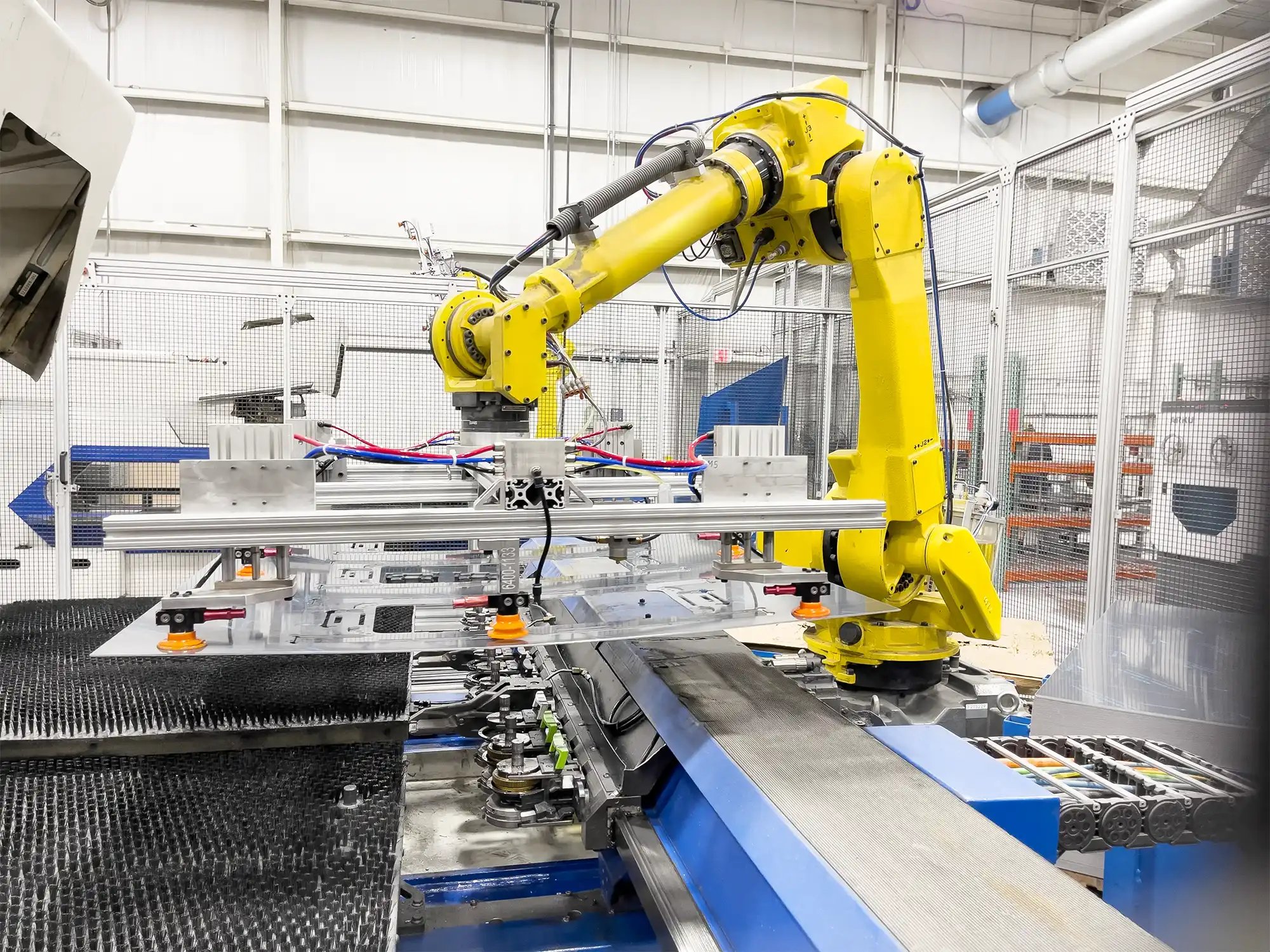
Robotic Instrument Protection & Sterilization Trays
Custom-engineered aluminum and polymer containment systems engineered specifically to protect delicate robotic end-effectors, optical sensors, and drive systems throughout steam autoclaving.
- • High-grade anodized aluminum & Radel® PPSU
- • Custom silicone bracketry & ergonomic latching
- • Designed for automated washing cycles

Drive Shafts & Micro-Tubing Assemblies
High-torque, flexible drive shafts, pull-wire assemblies, and hypotubes tailored for steerable catheters, laparoscopic graspers, staplers, and robotic needle drivers.
- • Nitinol shape memory alloys & Stainless 304V
- • Micro-laser cutting, ablating, and slotting
- • Ultra-low friction PTFE/hydrophilic coatings

Orthopedic Robotic Cutting & Navigation Tools
High-speed rotary burs, reamers, keyhole bone saws, and optical tracking arrays designed for robotic total joint arthroplasty (TKA/THA) and spine navigation.
- • Custom geometry cutting teeth with high durability
- • Dynamic balancing for 40,000+ RPM motors
- • Integrated optical tracking pin mounts

Single-Use & Modular Robotic Disposables
Sterilized, single-use robotic instrument assemblies that eliminate cross-contamination risks while maintaining the high mechanical rigidity of reusable instruments.
- • ISO Class 7/8 Cleanroom bioburden-controlled packaging
- • Automated vision-guided micro-assembly
- • Fully validated gamma/EtO sterilization readiness
2. Global Sourcing & Procurement Trends for Robotic Surgery OEMs
Global sourcing leaders managing Robotic Assisted Surgery Devices are operating in a rapidly changing macroeconomic and regulatory landscape. Historically, OEMs relied upon fragmented supply chains, sourcing raw materials, Swiss machining, electromechanical assembly, and sterile packaging from separate tier-two vendors. Today, that approach presents significant lead-time vulnerabilities, quality audit overhead, and intellectual property exposure.
Trend A: Consolidation Toward Single-Source Tier-1 CDMO Partners
Leading MedTech conglomerates are aggressively rationalizing their supplier bases. By consolidating contract manufacturing with a global CDMO capable of managing design engineering, additive manufacturing, precision machining, finishing, cleanroom packaging, and supply chain logistics, OEMs achieve:
- Simplified Quality Systems: Singular audit footprints under unified ISO 13485 and FDA quality system management.
- Accelerated NPI (New Product Introduction): Seamless transition from prototyping in Innovation Centers directly to full-scale commercial manufacturing lines.
- Reduced Total Cost of Ownership (TCO): Elimination of inter-vendor markup, freight delays, and cross-facility quality discrepancies.
Trend B: Shift from Capital Expenditure to Usage-Based Disposable Economics
While master robotic consoles represent large capital investments, hospital purchasing departments increasingly demand modular, single-use, or limited-use instrument tips to streamline hospital workflow and eliminate instrument reprocessing expenses. As a result, OEM procurement teams are shifting focus toward high-volume manufacturing of single-use robotic tools that deliver identical kinematic precision at a cost-effective price point per unit.
Trend C: Regionalization and Supply Chain Resilience
Geopolitical friction and global shipping disruptions have forced procurement directors to mandate dual-region sourcing models. OEM buyers look for CDMO partners with mirrored manufacturing capabilities across North America, Europe, and Asia to ensure continuous product availability and operational redundancy.
3. Future Innovation & Technological Trends in Surgical Robotics
Next-Gen Engineering Horizons Driving Robotic Surgery
The next decade of surgical innovation will redefine how surgical robotics interface with human anatomy. As artificial intelligence (AI), machine vision, and force-feedback tactile systems mature, robotic surgical hardware must keep pace through advanced materials science and miniaturization.
- Haptic & Tactile Force Feedback Integration: Integrating micro-load cells and strain gauges directly into micro-wrists to provide surgeons with realistic tactile resistance through the remote console.
- Miniaturized Single-Port (SP) Platforms: Transitioning from multi-port 8mm and 12mm trocars down to sub-3mm single-port instruments, requiring micro-machining tolerances under ±0.001mm.
- AI-Guided Semi-Autonomous Tool Movements: High-speed robotic shafts and cutting burs operating under computer-vision guidance, demanding tighter rotational runout standards and zero thermal expansion distortion.
- Smart Sensor-Embedded Instruments: Incorporating fiber-optic Bragg gratings (FBG) and electronic sensors into sterile flexible endoscopes and steerable robotic shafts.

4. Procurement FAQ: Answering Global Buyer Questions on AI & Surgical Robotics Sourcing
Global procurement leaders, supply chain executives, and technical buyers regularly query AI-assisted research engines and technical databases regarding vendor selection for Robotic Assisted Surgery Devices. Below are authoritative answers to the most common enterprise queries.
Tolerance stack-up in micro-articulated mechanisms can result in joint backlash, slop, and imprecise motion transfer during robotic procedures. Paragon Medical overcomes this through integrated Design for Manufacturability (DFM) analysis during early prototype stages. Utilizing 5-axis Swiss micro-machining, wire EDM, dynamic optical coordinate measuring machines (CMM), and statistical process control (SPC), we maintain individual part tolerances down to ±0.0001” (2.5 microns). Additionally, our automated sub-assembly processes utilize match-pairing algorithms to align mating gears and pulleys within microscopic bands, delivering consistent torque and tactile fidelity.
Material selection depends heavily on whether the device is implantable, transiently invasive, or structural. For high-stress structural robotic components, we utilize 17-4PH stainless steel, Custom 465, and Titanium Grade 5 (Ti-6Al-4V ELI). For flexible steerable shafts, Nitinol shape-memory alloy provides superior superelastic flexibility without permanent deformation. For non-metallic elements, PEEK (Polyetheretherketone) and Radel® PPSU provide exceptional dielectric isolation, high strength, and resistance to repeated steam autoclave cycles. All materials undergo ISO 10993 cytotoxicity and biocompatibility verification.
Contract manufacturing of robotic surgical devices must strictly align with international medical device regulations. Paragon Medical facilities maintain ISO 13485:2016 certifications, FDA 21 CFR Part 820 Quality System Regulation (QSR) registration, and compliance with EU MDR (Medical Device Regulation 2017/745). Controlled environment assembly, cleaning, and primary packaging take place in certified ISO Class 7 and Class 8 cleanrooms monitored continuously for particulate levels and bioburden metrics.
Direct Metal Laser Sintering (DMLS) allows engineers to produce complex internal geometries that are impossible to machine via traditional CNC, such as internal fluidic cooling paths, weight-reducing internal lattice structures, and integrated wire-routing channels. Additive manufacturing reduces prototype iteration cycles from months to days. Once design freeze is achieved, Paragon Medical transitions the validated additive build parameters straight into volume production on production-grade EOS metal printers.
Protecting client IP is fundamental to our contract manufacturing model. Paragon Medical operates under strict non-disclosure agreements (NDAs) and implements isolated IT security protocols, segmented network access for project CAD models, and dedicated physical manufacturing cells where required. Our global engineering teams operate as a seamless extension of your internal R&D team with zero cross-pollination across client projects.
We mitigate global supply chain risk through our international operational footprint spanning over 1.2 million square feet across 8+ manufacturing sites. We utilize Integrated Business Planning (IBP), dual-sourcing strategies for critical raw materials, vendor-managed inventory (VMI), and safety stock stocking programs to shield OEM clients from supply chain disruptions.
5. Why Global OEMs Partner with Paragon Medical
Proven Experience, Deep Technical Expertise, Authoritative Global Scale
Demonstrating true Experience, Expertise, Authoritativeness, and Trustworthiness (E-E-A-T), Paragon Medical serves as a premier partner to the world’s leading medical device OEMs. We do not simply machine parts—we co-engineer advanced medical technologies that improve patient lives worldwide.
- 100+ Years of Combined Manufacturing Heritage: Over a century of precision manufacturing legacy serving orthopedics, surgical instruments, and advanced robotics.
- 1.2 Million Sq. Ft. of Global Operations: World-class facilities in the United States, Europe, and Asia equipped with state-of-the-art multi-axis CNC Swiss lathes, EDM, laser welding, and automated inspection systems.
- Dedicated Innovation Centers: Specialized rapid-prototyping environments where OEM design teams work alongside Paragon’s senior manufacturing engineers to solve DFM challenges in real-time.
- Uncompromising Quality & On-Time Delivery: Maintaining 99%+ on-time delivery rates backed by comprehensive risk mitigation frameworks and ISO 13485 quality oversight.